Showing posts with label Romeo Castellucci. Show all posts

Sunday, 24 March 2024

Wagner - Die Walküre (Brussels, 2024)


Richard Wagner - Die Walküre

La Monnaie-De Munt, 2024

Alain Altinoglu, Romeo Castellucci, Peter Wedd, Nadja Stefanoff, Ante Jerkunica, Gábor Bretz, Marie-Nicole Lemieux, Ingela Brimberg, Karen Vermeiren, Tineke Van Ingelgem, Polly Leech, Lotte Verstaen, Katie Lowe, Marie-Andrée Bouchard-Lesieur, Iris van Wijnen, Christel Loetzsch

RTBF Auvio Streaming - 8th February 2024

It's hard to describe a Romeo Castellucci production in any way that makes logical or narrative sense, especially when you're only half-way though it. That's as far as we have got with his production of Der Ring des Nibelungen cycle at La Monnaie, and at this stage with Das Rheingold presented earlier this season, the most we can say after Die Walküre is that the focus is very much on tone rather than narrative. It's an approach that is designed to avoid the conventional imagery for one that marries spectacle worthy of the status of the mythology with an intent to delve deeper into the emotional and ideological nature of the work as expressed in the music. If there's a work that can sustain many layers it's Wagner's Ring and Castellucci certainly is aiming to bring a unique response and new ideas to this tetralogy of operas.

What those ideas might be however is still hard to define at this stage, but in terms of mood and character and tone it already has made a considerable impact, particularly with the musical direction under the baton of Alain Altinoglu. That tone is set straight away in Die Walküre - as it ought to be - by the opening storm that shows a Siegmund being battered against a screen bearing a faint imprint of a ring/circle by a gushing torrent of water. His predicament is clear. Less clear maybe is the colourful apparel that Hunding's wife presents him with when welcoming him unwittingly into the trap of her home, but a pacing wolf-like black dog and a shifting array of oppressive rooms, cabinets, wardrobes and furniture enclosing the two of them in tight spaces fits perfectly with the threat that this stay presents to the Walsung.

Why Hunding reposes in what looks like a confessional however is anyone's guess, the set transforming from darkness to light, the set turning minimalist with only the confessional, a bed and a fridge shifting around the open space. The sword Nothung is not buried in an ash tree but borne by or perhaps actually buried in Sieglinde. Removed, it is stored in fridge while Siegmund and Sieglinde welcome the sudden arrival of spring by burying each other in flowers and rolling around in blood, enact a baptism or kind of rebirth as brother and sister in blood. The least you can say is that stagecraft is remarkable and holds attention even if it is hard to rationalise, the shifting props and minor adjustments of lighting, smoothly and imperceptibly changing from one scene and mood into another.

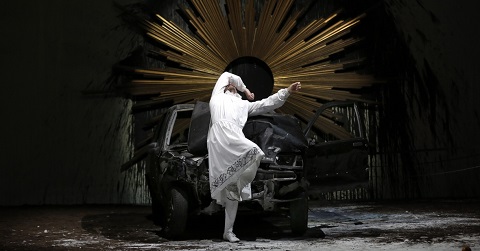
If you think Act I was peculiar, Act II despite being again rather minimalist in overall approach has many more eccentric touches, too many to go through every one of them all and you'd be none the wiser even if they were described. What matters is whether it gets across the gravity and import of this lynchpin scene of this opera and debatably the whole tetralogy. What it seems to focus on is the opposition of ideals and philosophies of the opposing forces within Valhalla, or at the very least find visual ways of establishing their character. Fricke enters Valhalla in an extravagant white wedding gown with a troupe of similarly attired followers, fairly shaking with rage at the mockery Siegmund and Sieglinde have made of the sacred sacrament of marriage. She crushes some white doves while Wotan washes the head of a statue of Buddha with milk. Whether you take any deeper meaning from this or not, there is no reason why these gods should behave as ordinary mortals.

For his part, Wotan recounts his folly and his failure to Brünnhilde wearing a red blindfold with dark semi-invisible figures of his entourage waving flags that spell IDIOT behind him. Brünnhilde's steed Grane is seen as nothing more than disembodied skeletal floating lower legs, again operated by invisible extras. Brünnhilde is crushed momentarily beneath its hoof at the weight of Wotan's will and command to the Valkyrie. Act II of course is all about revisiting the past and determining the future, and it can be a little dry, so these visual theatrics can help establish the nature of what transpires, but it's hard to see that these add anything, or really understand their intent. It seems to get even sillier still when Brunhilde gives Siegmund an orange while advising him of his fate on shifting sands, all of Act II delivered in the gravest intonations, before shapeless creatures smother him. Regardess of what you make of it, musically, vocally and in terms of the tone you expect, it delivers the depth of intensity of the Act.

Likewise, Act III fires into the Ride of the Valkyrie with the same full dark intent. These are Valkyrie to truly strike terror into the soul as, dressed in black robes with helmets and shields, they drag the hairless naked bodies of fallen heroes to their final resting place in Valhalla in the enveloping bleak darkness of the stage. The final scene between Wotan and Brünnhilde is completely stripped back to black as a large white screen is lowered and tilted over them, with only a few ominous shadows rippling across on the other side of the veil behind them. There is a brief burst of flame in a circle, the shape of the ring that has become the connecting or defining element between the beginning and end of each of the two operas so far. Nothing else is needed really when Alain Altinoglu conducts the orchestra to bring out every nuance of emotion and sensitivity from the scene.

The La Monnaie Die Walküre is given a very different treatment to the one in Das Rheingold. It's a dark shadow world for the larger part of this opera, the world unformed and unstable, from the shifting furniture of Hunding's abode in Act I, the pacing wolf, the swarming figures that swallow Siegmund, the dark mounts of the Valkyrie that pass by in the background. Individually, these things might not add up to anything meaningful, but collectively they establish a specific mood, finding the necessary balance of darkness and light (admittedly more darkness than light in this work). Like Frank Castorf's extraordinary Bayreuth Ring, Castellucci is clearly not going to be restricted to a single style across this cycle, adapting to the distinct character of each of the works and the opportunities they offer. So far however it lacks the thematic rigour of Castorf's Ring and an overall concept hasn't yet emerged other than this idea of a circle or ring being a key image, which is appropriate but hardly revolutionary.

Some might expect more from Romeo Castellucci on this epic tetralogy, but so far Das Rheingold and Die Walküre have been successful in their own context and who knows whether certain visual leitmotifs might not recur in the next two works (probably not). Certainly the musical direction of Alain Altinoglu provides the necessary heft that you would expect and perhaps the intent is to let the language of the music speak more strongly here, with the visual element supporting that in a more abstract fashion. There are some interesting choices made as far as the casting goes, and I'm all for bringing new voices into the world of Wagner, but not all of them are convincing this time around.

I wasn't too keen on the trills introduced by Nadja Stefanoff's Sieglinde in Act I, but she is excellent in the subsequent acts, looking truly anguished rather than dramatically acting it as seems to be the case with Peter Wedd's Siegmund, a joyless Wehwald. Too many of the performances are operatically earnest, the movements too choreographed to show any real feelings. It seems to afflict Gábor Bretz this time around, his delivery inexpressively intoned with little emotional engagement. There is little sign of resignation you expect from Wotan in Act II or fury in Act III. Marie-Nicole Lemieux is another fine singer who was introduced to to the Wagnerian repertoire in Das Rheingold and her Fricka here is capable, her performance good but perhaps not outstanding or as commanding as you might like. For me, Ingela Brimberg's was the most impressive here, connecting deeply with the different sides of Brünnhilde, but all of the Valkyrie were formidable on a scale commensurate with the mythology of the Ring. Whether we can say that about Castellucci's direction of this Ring cycle remains yet to be seen. 


Sunday, 5 November 2023

Wagner - Das Rheingold (Brussels, 2023)


Richard Wagner - Das Rheingold

La Monnaie-De Munt, 2023

Alain Altinoglu, Romeo Castellucci, Gábor Bretz, Andrew Foster-Williams, Julian Hubbard, Nicky Spence, Marie-Nicole Lemieux, Anett Fritsch, Nora Gubisch, Scott Hendricks, Peter Hoare, Ante Jerkunica, Wilhelm Schwinghammer, Eleonore Marguerre, Jelena Kordić, Christel Loetzsch

RTBF Auvio live stream - 31st October 2023

If you've ever watched an opera production directed by Romeo Castellucci, you'll know not to expect anything straightforward or traditionally narrative driven. It's probably better to think of his work as closer to installation or conceptual art than opera performance direction. There are a lot of conservative opera-goers who don't like the idea of that one bit, but the idea of bringing that style and approach with a willingness to extend theatrical techniques to a work like Wagner's Der Ring des Nibelungen is thrilling, and this is surely a work that is more conceptual than it is narrative and worthy of such deeper exploration and consideration.

Depending on your view then, Castellucci actually keeps things relatively simple in the opening work of the new Ring cycle at La Monnaie, although some will surely see this Das Rheingold completely overhauled and distorted beyond recognition. Both things are possible at the same time, but also neither are completely the whole story here. If you want to relate the instances of idiosyncratic imagery as representative symbolism, much of what is seen in this Das Rheingold doesn't necessarily serve any meaningful purpose, but there is no reason it should, unless you believe that Wagner's stage instructions should be followed to the letter, and a lot of people do.

The first thing you see on the stage is a huge spinning metallic ring, which is as simple and direct an image as you can get for an opening of a Ring cycle. This gives way after the opening famous 136 opening bars in E-flat major to the scene of three almost entirely naked gold-painted Rhinemaidens frolicking and writhing together in darkness and gold-lit vapour with dancer doubles in a way that inflames Alberich's (gold) lust. It's as effective a way of getting as close to that primal state of the mythological founding origin of the earth/universe as you can imagine, and Castellucci has some imagination.

Valhalla reverts to the almost clean white minimalist set that is characteristic of Castellucci, but with classical Greek statues and friezes, the gods dressed in black robes and crowns, tiptoeing their way through a sea of naked-looking bodies (another familiar Castellucci trope) in modesty saving flesh-coloured garments; little people crushed by the grandeur of Wotan's vanity or workers exploited for labour by the giants? It's open to whatever interpretation you like. The result however is clear, that there is a price to be paid for this. Rather than make the giants appear larger than life as most productions might, if they bother at all, the director here substitutes the singers of family of gods for children who mime the singing. It's not just a gimmick, but a clever and effective way of showing the reversal of power that their vanity has imposed on them, and similarly they become old and enfeebled played by elderly actors as they realise that they have to obtain the Rhinegold in order to save Freia and her rejuvenating golden apples.

The Niebelheim scene also relatively straightforward again presenting strong contrasts, dark and industrial but not overly decorated, with just one machine that seems to specialise in creating large rings of a diameter of about two metres across. Even the Tarnhelm is a ring that Alberich hangs around his neck, disappearing into dark mists. It's superbly atmospheric with Mime and Alberich marvellously deformed creatures. Alberich's Tarnhelm transformation is created by him peeling off his rubber bodysuit to be captured naked, tortured and smeared in black oil in the empty Castelluccian white space. Scott Hendricks handles this humiliation of Alberich bravely and it is also dramatically effective, transforming this world into something alien but recognisable, the horrors of what occur feeling very real. Another nice touch that adds to this is where Alberich's curse becomes a black smear that the dwarf leaves down one side of Wotan's face and eye.

That's all relatively simple and direct for this director, although of course there are lots of other little eccentric touches; the playful and disrespectful Loge throwing ink bombs at photos of classic cast members of Ring operas in the past wearing winged helmets and breastplates, Fasolt killed by a giant crocodile falling from the sky, Erda a headless statue sitting in lotus position. Does it add up to anything in terms of a concept or commentary? Well you could see the now almost obligatory condemnation of consumerism in a society that is heading towards late capitalism meltdown, but the parallel is not made explicit or over-emphasised as it might have been in the Chereau/Boulez Ring at Bayreuth, or indeed Frank Castorf's more recent cycle there. It's not just decorative either, although it is that too (it looks stunning), but it's too early in the cycle to pin down to one simplistic reading. There will certainly be plenty of other opportunities for the director to build on or diverge from any interpretation placed on the opening chapter.

It's all to little avail of course if you can't bring the requisite musical and singing forces to Das Rheingold, there can be no concerns at all with the La Monnaie production; even if few are familiar or experienced Wagnerians, the casting and singing is impressive right across the board. This is the first time I've seen Gábor Bretz singing Wagner and he makes for a grave, resonant and commanding Wotan. I wouldn't associate Marie-Nicole Lemieux with Wagner either, but she is an excellent Fricka, heartfelt in her fears for what horrors her unfaithful husband has visited upon the gods. It will be interesting to see how she handles the role of the much less forgiving wife in Die Walküre. Anett Fritsch is a superb Freia, and Scott Hendricks very impressive as Alberich. He is not always this reliable, but this is one of the best and most consistent performances I've seen from him. Nicky Spence makes the mischievous playful schoolboyish Loge seem effortless.

Musically, this is also a real treat with Alain Altinoglu conducting the La Monnaie orchestra in the first Ring cycle there in 30 years, and this looks like it will be a memorable one. With not so much an ascent to Valhalla on the rainbow bridge, the gods at the conclusion to this Das Rheingold drop into the pit of the ring, dressed in white like members of a death cult, accepting the course that fate has placed them on. This is everything you want from the start of a Ring cycle; epic and spectacular, visually and emotionally stimulating, with impressive singing and musical direction. To be presented at La Monnaie across two seasons, with Die Walküre to follow in January 2024, Romeo Castellucci delivers a majestic, intriguing Das Rheingold, serving the work in his own particular style and visual language, leaving the way open to explore the further riches of the remaining parts of the tetralogy.


Wednesday, 24 August 2022

Mahler - Resurrection (Aix-en-Provence, 2022)

Gustav Mahler - Resurrection

Festival Aix-en-Provence, 2022

Esa-Pekka Salonen, Romeo Castellucci, Golda Schultz, Marianne Crebassa, Maïlys Castets, Simone Gatti, Michelle Salvatore, Raphaël Sawadogo-Mas

ARTE Concert - 13th July 2022

I don't think we need to get into a debate about what is an opera and what isn't. The definition is so wide now that there are works with less singing and drama and indeed music than Mahler's Second Symphony. There can be little argument however about the fact that Auferstehung, Resurrection, was conceived as a symphony, but symphonies have a narrative of their own and Mahler's symphonies are by no means conventional. The composer might have had his own intentions for the work but the listener is free to let the music speak directly to each of us as individuals and interpret in their own way. Romeo Castellucci, much as many begrudge him even directing an opera in his own way, is likewise free to do so, and comes up with a bold visual narrative for this performance of Mahler's great work (they are all great as far as I'm concerned) for the Aix-en-Provence festival.

Knowing Castellucci, and knowing indeed what he made of Mozart's Requiem for the 2019 Aix-en-Provence Festival, his vision for what we think of as a resurrection is certainly far from what either you or indeed Mahler might have imagined. Almost as a companion piece to the Requiem, this time there is little in the way of a set for Resurrection. The location of the abandoned and graffiti vandalised sports stadium in Vitrolles is in a way 'resurrected' for this production and performance of Mahler's Symphony No. 2. The audience however are greeted with the site of an empty mud covered floor to look down on, as a white horse wanders onto the muddy expanse that constitutes a "stage". His owner comes looking for the horse and finds nearby what looks like the remains of a body. After a panicked phone call a UNCHR team in white overalls begin digging up not just one buried body but discover that they have begun excavating a mass grave.

By any standards, it's a grim notion of a resurrection. In a way though it is a true modern secular idea of a resurrection, one that nonetheless has a meaningful role to play for many families who have lost family in such horrendous circumstances that constitute war crimes all over the world. Buried in mass graves, their recovery, identification and re-burial is a resurrection of sorts, one that allows the dead to be accorded after death and burial with a dignified and proper interment, as well as giving grieving families the release of knowing what has happened to their loved ones and the opportunity to pay respects. So yes, a resurrection of sorts, a necessary disinterment, even if it is quite a grim process.

Castellucci's production spares the viewer little of the grim reality of such a find. It is a frighteningly realistic depiction of just how such a process would take place. Emaciated semi-decomposed bodies, including a number of children and newborn babies, are unearthed by hand and delicately lifted over to be placed in rows on white sheets. Vehicles for heavy digging are brought in as the scale of the horror becomes evident, vans arrive for the collection and the forensic examination of the bodies. There is little of the familiar Castellucci abstraction or symbolism here, this is as direct as it gets. If the audience were unaware of what would take place, this would certainly come as something of a shock.

That sense of shock, or deep emotional impact is undoubtedly provoked just as much by the scene being set against Mahler's powerful, expressive and deeply emotional music, conducted here by Esa-Pekka Salonen. I've questioned before (in Calixto Bieito's Turandot) how far it is necessary and permissible to stage indescribable horrors, and whether the opera stage is really a suitable vehicle for such statements. There of course should be no limits to artistic expression, even if it feels like there is a subversion where the intentions of an original work of art are used to express something other than they are intended. That's down to the individual to react or take what they wish, but it's certainly is important that an artist is free to interpret as they see fit.

What is essential for any work of art - particularly performance art - is that it remains vital and meaningful. Musical fashions change and even Mahler might not withstand the reality of philistinism from deeply conservative and right-wing culture war attacks on multiculturalism and freedom of expression as a means of stirring up fear and division. (Bieto's Turandot more or less addresses this). As far as Resurrection goes, Castellucci piles horror upon horror that no viewer could remain unmoved by what is shown, and there is evidently justification for showing it this way. This however is only a stage representation. Imagine how utterly devastating it must be to know that such situation are not uncommon in real-life.

You don't need examples to confirm that such scenes have taken place and many times even in living memory. It's not even really a surprise that even as this production was being conceived and developed, that similar gruesome discoveries were being made in Mariupol in Ukraine. Dealing with such a subject in this day and age, there is no place for Castellucci provocation in the staging or for sentimentality in the musical performance, and both were resolutely direct and had real impact. The text of Des Knaben Wunderhorn in the fourth movement, sung by Marianne Crenbassa certainly hit home, as did Golda Schultz as the soprano in this performance. With superb choral work, the production unearthed and laid bare the underlying humanism and spirituality of the various stages of the process of death, mourning and rebirth in this remarkable work.


Links: Festival Aix-en-Provence, ARTE Concert

Wednesday, 25 August 2021

Mozart - Don Giovanni (Salzburg, 2021)


Wolfgang Amadeus Mozart - Don Giovanni

Salzburger Festspiele, 2021

Teodor Currentzis, Romeo Castellucci, Davide Luciano, Mika Kares, Nadezhda Pavlova, Michael Spyres, Federica Lombardi, Vito Priante, David Steffens, Anna Lucia Richter

ARTE Concert - 8th August 2021

There are many facets to Mozart and Da Ponte's trilogy of operas, many facets of human behaviour that can be explored in them, universal traits that provide no easy answers to questions that on the surface can appear - and be played - as comedies but which underneath touch on some very disturbing subtexts. Don Giovanni can be depicted as villain or a victim of his own lusts - someone who loves too much, as someone who just isn't used to taking no for an answer, or in today's view, as a sexual predator and abuser of women. Don Giovanni is always worth a fresh perspective, but - perhaps more controversially (and it isn't often you can say that there is something more controversial in a production than the stage direction of Romeo Castellucci) - Mozart's score is also worth looking at in new ways. 

Teodor Currentzis has been upsetting those who like their Mozart played in the familiar Classical style for quite a while, but he's certainly not the only conductor finding more interesting facets to Mozart using historically informed direction on period instruments and using reduced ensemble orchestration. With Mozart's opera seria works that might be more palatable - and Salzburg have presented interesting Currentzis directed productions of La Clemenza di Tito in 2017 and Idomeneo in 2019 - but Don Giovanni is a different matter altogether. Rather than simply playing it to a way that has become rote and unadventurous over the years, Currentzis again seeks new ways to explore and express the wealth of character that is within Mozart's music. Forcing the listener to really listen to it. Making it feel fresh, shiny and new again. Like a virgin.

There's a theme that a director like Castellucci would certainly seize upon in a work like Don Giovanni, but there are less obvious ways to approach that. And there's maybe an allusion to stripping away the image of the sanctity of Mozart being forced into accepted conventional interpretations in the opening scene of Salzburg's Don Giovanni. In a white temple like setting, workmen strip away the Christian iconography of a church, leaving the elegant bare white edifice to show its basic underlying structure, ready to be built upon anew. A flame burns away any remaining holiness and indeed, the first person seen on the stage is a naked woman (well, it is Castellucci), one presumably no longer a virgin, since she has evidently been seduced/raped by Don Giovanni.

Rather than keep it simple and minimal, Castellucci then bombards the stage with all manner of effects, symbols and supernumeraries. A car crashes down on to the stage, a wheelchair, basketballs, a broken piano. Don Giovanni, Leporello and the Commendatore are dressed in white, while the avenging Donna Anna comes storming on in black with a retinue of Furies that surround and strive to bring Don Giovanni to justice for his crimes against women. It looks like Don Giovanni has juggled too many basketballs this time. The recitative as Don Giovanni and Leporello make their escape is played out with cartoon eyes on a black screen, Donna Anna mourns the crutch of Commendatore, Don Ottavio pours red powder on his arms and punctures a line of basketballs in his promise of securing revenge.

This is evidently not the Don Giovanni you might be familiar with but neither is it inappropriate to the tone of the work and its treatment by Mozart and da Ponte. It might do something different with the visuals and the pace, the use of instruments and emphasis of the music, but it still engages with the themes and the tone of the work. It's not so much Don Giovanni's debauchery and libidinous lifestyle that are condemned here as much as his failure to accept responsibility for and deal with the consequences of his actions. He leaves death and the destruction of lives behind him (something seized upon with a more political slant in Michael Haneke's version), including a suggestion that he has abandoned a pregnant Donna Elvira (Federica Lombardi doubled with a naked pregnant woman), while a child also pursues Don Giovanni on the stage.

The lightness of the treatment and the heaviness of the underlying implications is borne out in the music. Leporello's 'Madamina, il catalogo è questo' has a lovely lightness, the piano weaving in and out of the musicAeterna arrangement, the beauty of the aria contrasted with the sinister note behind the revelations of conquests. Castellucci provides plenty of contrasting imagery, mixing the absurdity with the comedy, with pointed symbolism and contemporary references that include a photocopier. Likewise he brings Michael Spyres's Don Ottavio on wearing a Danish mountaineer outfit (a familiar inscrutable symbol also used in his Moses und Aron) accompanied by a poodle. It looks ridiculous (several characters have a live animal avatar - Masetto a mouse, Don Giovanni a goat) but takes nothing away from the chilling account of Donna Anna on the recognition of her father's murderer, the scene re-enacted as a Greek tragedy.

Which is something that the legend of Don Giovanni could certainly be said to aspire to, it not being entirely out of place with the opera seria reworkings of mythology that preceded Mozart in the earlier part of the 18th century. Just as Mozart brought a contemporary edge to that genre in his progressive music and Da Ponte in the humanisation of the drama while still retaining the otherworldly elements that elevate it to grand drama - so Castellucci brings a corresponding touch of re-interpretation of an epic myth for a modern age while reflecting and respecting the underlying complexity of the work's blend of surrealism, comedy, tragedy, symbolism and instruction on the consequences of moral dissolution. In an expansive gesture that brings 150 women as extras to the stage, Don Giovanni here is held to account for his crime not by a stone statue, but by the women he has wronged. 

Teodor Currentzis seems to be doing his best to submerge as much as possible any of Mozart's familiar melodic embellishments. Whether this is for the sake of upsetting those who like their Mozart played in a conventionally acceptable way, whether it's out of sheer bloody-mindedness to stake out is reputation for being a fearless re-interpreter of Mozart, or whether he finds it appropriate to reevaluate and strip away the varnish of mannerisms that the work has accrued over the years and present a more historically informed account of the score is something the musicologists can argue over. Aligned with the drama an Castellucci's sensibility, the music however doesn't lose a fraction of its distinctive Mozartian qualities of beauty, sensitivity or dramatic flair.

Think what you might also of Romeo Castellucci's contribution, whether it adds any value or provides any new insights but - much like his stunning Die Zauberflöte for La Monnaie - it's certainly original, often spectacular and rarely dull, always surprising with some new idea that puts emphasis on different aspects of the work. It's also not without the occasional bit of flash/bang showmanship, which Mozart wasn't beyond employing himself. Castellucci has become a stylist in white haze, his productions as distinctive now as Robert Wilson's geometric minimalism in blue, and just as visually arresting in their conception, design and execution. This looks simply stunning and impressively choreographed.

It has to be said however, that it's more of an "interesting" production than a great one. Despite the efforts to bring "real people" onto the stage (see Castellucci's rather more successful Die Zauberföte again) and the impressive efforts to pull it all together into a coherent whole, it doesn't always succeed in finding the human warm within the work where it traditionally should. The idea of making Don Giovanni and Leporello look almost identical is another fine idea that makes the identity confusion more realistic, but it also loses something when the two baritones are practically indistinguishable.

Perhaps just as much at fault as the production, the singing didn't quite measure up or compensate for the lack of human warmth in the production. The singing is generally fine, and of a very high standard, as you would expect, but despite good performances from Davide Luciano as Don Giovanni (stripped fully naked at the finale) and Vito Priante as Leporello, and with perhaps the sole exception of a mighty performance from Nadezhda Pavlova as Donna Anna, the production never allowed you to engage with any of the characters of at least sympathise with their dilemma. Overall, this feels like an admirable production with good ideas and visuals, that despite its controversial trappings, plays out nonetheless in a rather run of the mill fashion.

Links: Salzburg Festival, ARTE Concert

Monday, 16 September 2019

Mozart - Requiem (Aix, 2019)


Wolfgang Amadeus Mozart - Requiem

Festival d'Aix-en-Provence, 2019

Raphaël Pichon, Romeo Castellucci, Siobhan Stagg, Sara Mingardo, Martin Mitterrutzner, Luca Tittoto, Ensemble Pygmalion

ARTE Concert - 10 July 2019


Romeo Castellucci's directorial projects are becoming less interested in the traditional narrative aspect of opera direction and more concerned with exploring and representing the spiritual side of humanity within the works. Of course, the works in question have to be capable of possessing this quality, and that's certainly the case for the likes of his La Monnaie Parsifal, his Paris Moses und Aron and his Hamburg Matthew's Passion. More recently he has set about exploring this in other less obviously spiritual works, in Salome for Salzburg and Tannhäuser for Munich, but perhaps the most interesting exploration of the spiritual existing with the physical nature of humanity has been in his stunning La Monnaie production of Die Zauberflöte. Mozart is of course fully open to be explored in this area and nowhere more so than in the Requiem.


Mozart's Requiem however isn't an opera, and the idea of setting it to a manufactured narrative would evidently be presumptuous, if not actually impossible. For the purposes of this Aix-en-Provence production - an ambitious one in Pierre Audi's first season as artistic director of the festival - Castellucci associates the work with a growing awareness of the temporality of human existence as individuals and as a species, as well as the fleeting impermanence of what our relatively brief presence on the planet leaves behind. The best way of looking at this approach to Requiem is that the director is seeking a way to extend the work far beyond its own confines, showing or at least suggesting connections it makes - musical, spiritual and existential - to the condition of being human and being mortal.

To extend the scope of Requiem further for this purpose, Castellucci makes use of several other Mozart sacred pieces and Masonic hymns in including the Kyrie from the Mass in C Minor, O Gottes Lamm, and opens the theatrical presentation of this work with a Gregorian chant. Essentially, this production of Requiem becomes a ritual of song and dance, celebrating life in the face of the certainty of extinction. It's this theme that dominates as, in typical Castellucci fashion, words are projected to the back of the stage, an 'Atlas of Extinction', that enumerates the extinction of creatures that no longer exist, to extinct plants, disappeared lakes, extinct tribes and races, extinct cities, lost languages, religions, buildings and works of art.


It's a fascinating device that really has an impact in conjunction with the performance and the music, showing that as well as being something sad there's also something beautiful in the contemplation of the awareness that all things come to an end. The catalogue however doesn't restrict itself to known extinctions but gnomically reminds us in its list of "present-day extinctions", of the extinction of I, of the extinction even the of the word I, of wind, water, grass, thought, fish in the sea, time, even the extinction of this music. And ultimately of course, an extinction of this day, the 10th July 2019. Indeed, if there is anything that can testify to the glory of human existence over its relatively short presence on Earth, it's Mozart's Requiem. Eternal rest grant unto them.

On the stage meanwhile, Romeo Castellucci makes use of the Pygmalion Vocal Ensemble to enact ritual dances for Mozart's music, placing quite a different character on the work that you would typically get from a solemn concert performance. Moving ever closer towards performance art or art installations, Castellucci has extras representing all the ages of woman (from old age to birth) splatters the stage and bodies with Holi-like coloured power and honey, with soil, spray painting the backdrops, as the chorus move into formations to put on folk dances, a maypole dance and ritualistic representations of life and death, all the while that Mozart's music plays and the backscreen runs through its seemingly endless catalogue of extinction.


Seen in this context it's extraordinarily beautiful, invigorating, thought-provoking and often very moving; but even so, the question remains about whether it is worthy of Mozart's music. I return to that statement at the start of the presumption or impossibility of staging Mozart's Requiem, or believe that it can be elevated to anything greater than it already is. Given that, yes, Romeo Castellucci creates a presentation that is indeed worthy of the piece as a sincere artistic response to this great work. Like Katie Mitchell's and Raphaël Pichon's attempt to do the same for J.S. Bach at the 2014 Aix Festival (Trauernacht), or indeed like Robert Wilson's reworking of Arvo Pärt's sacred music for Adam's Passion, it is of course the music that must be the heart and soul of the production.

That relies of course principally on the musical direction of Raphaël Pichon, the Ensemble Pygmalion Orchestra and Chorus. Even in the open-air conditions of the theatre of the Théâtre de l’Archevêché in Aix in a theatrical presentation, the performances and the singing of the principals Siobhan Stagg (soprano), Sara Mingardo (alto), Martin Mitterrutzner (tenor) and Luca Tittoto (bass) - not to forget the beautiful acapella Kyrie by boy alto Chadi Lazreq - captures all the glory and solemnity of the work. It's not enhanced by the visual representation, but the busy and sometimes strange imagery of the production design doesn't detract from it either. What it does is prompt you to think about not just death but extinction, and as a mass for the death of everything, Mozart's Requiem couldn't be more fitting.


Links: Festival d'Aix-en-Provence

Sunday, 25 November 2018

Mozart - Die Zauberflöte (La Monnaie, 2018)


Wolfgang Amadeus Mozart - Die Zauberflöte


La Monnaie-De Munt, Brussels - 2018

Antonello Manacorda, Romeo Castellucci, Ed Lyon, Sabine Devieilhe, Sophie Karthäuser, Georg Nigl, Elina Galitskaya, Gábor Bretz, Dietrich Henschel, Tineke van Ingelgem, Angélique Noldus, Esther Kuiper

ARTE Concert - 27 September 2018

As if you couldn't already guess from the fact that it's Romeo Castellucci at La Monnaie, the opening pre-musical sequence alerts you pretty quickly to the fact that this is not going to be a 'traditional' Magic Flute by any means. A man walks onto the empty stage and throws a steel bar at a glowing glass neon tube until it breaks plunging the stage into darkness. Yeah, you think, it's The Magic Flute, we get it; light/darkness, enlightenment/obscurantism, a lot of ritual and symbolism. If you think Castellucci is going to be that obvious, you quickly realise that you're going to have to think again.

But yes, certainly Castellucci tends to find the big underlying contrasts or forces in conflict within an opera and brings them to the fore to the point where they are what the opera is all about. The actual stage directions and dramatic narrative are soon left behind as Castellucci usually starts to push those ideas even further into god knows where. (See his recent Moses und Aron or Tannhäuser). You might take for granted that Die Zauberflöte is all about masonic rituals with fairy tale characters and situations, but you're not going to see any of that in a Castellucci production. Doesn't that mean you lose something of the essential character of Mozart? Unquestionably yes, but can we trust Castellucci to give back something of equal worth?


Maybe not of equal worth, but there is something here in the La Monnaie production, no matter how obscure it gets, that approaches Mozart's work in a new way and provides a commentary on it as well as interacting and highlighting less familiar aspects of the work. There are perhaps no major new revelations and it might not all fit together in any way that is entirely comprehensible, but Castellucci does relate Mozart's Magic Flute to our experiences of the world today and that is bound to be more meaningful than any play on ancient masonic rituals, magic and obscure symbolism (not that Castellucci doesn't have even more obscure symbolism of his own).

So no, there's no serpent slain by Tamino and there's no traditional depiction of the three ladies. There's actually four here in the first Act and four boys too which totally screws up the numerology which is often considered to be important in the work. But is it really? By changing the numbers, Romeo Castellucci is able to steer the work in a new direction, one where symmetry and mirroring takes its place. There is certainly this contrasting of two sides of one human nature (an important aspect that Castellucci takes pains later to ensure is not neglected) in the divisions of the Königin/Sarastro, Tamino/Pamina, Papageno/Papagena, in male/female, in lightness/darkness, in rationalism/obscurantism, in good/evil.

It's also there in the division and structure of the opera itself and Castellucci contrasts the two Acts in a way that highlights aspects of the opera quite unlike anyone else has done before. Act I is all elegance, beauty, balance and symmetry in a uniform haze of brilliant white; by no means the obvious way to reflect this half of the opera, but if you like you can see it as a visual representation of Mozart's music itself. That's emphasised by the costumes which are period 18th century frock coats and powdered wigs. Papageno is indistinguishable from Tamino in identical elaborate costumes and there isn't a single scene, action or gesture that reflects the familiar course of the opera's dramatic action. You can be damned sure that there's going to be no actual magic flute or glockenspiel.


Instead figures move around in an elaborately choreographed display of symmetrical precision, with rotating patterns of white masked dancers, some topless with feather headdresses and fans like something out of the Crazy Horse in Paris. Architect Michael Hansmeyer's set designs however continue to accumulate detail, building up into an elaborate wedding cake or the stucco interior of some impossibly grand white cathedral. It is an extraordinary display, utterly beautiful, daring to ignore adherence to any traditional depiction of the drama in favour of just highlighting the elegance and beauty and symmetry in Mozart's music. It's something that is enhanced - or works both ways - with the nimble musical performance from the orchestra pit under Antonello Manacorda emphasising the melodic brilliance and effervescence with a wonderful lightness of touch.

As extraordinarily beautiful as it all looks, it's also a very cold and sterile way to approach Mozart and The Magic Flute, but of course that's only half the story. In direct contrast to elaborate representation of the music in Act I, Castellucci brings the work down to earth in Act II with a depiction of the human reality that can also be found in Die Zauberflöte which might otherwise be lost amidst all the comedy, symbolism and ritualism. Similar to his last production at La Monnaie, Orphée et Eurydice, Castellucci brings the experiences of real ordinary people in to highlight the underlying human reality of the questions of the trials endured by Tamino and Papageno. A group of six women talk about their personal experience of blindness and living in darkness, and a group of six men talk about surviving horrific burns in a 'trial of fire'.


In contrast to Act I the second half is depicted in mundane real-world terms in a warehouse environment, the glamorous fairy-tale white period costumes swapped for identical yellow-brown factory worker overalls and yellow-blond wigs. The performances are more dramatically realistic, you can at least sometimes tell characters apart from the labels on their back and there's even an actual flute! Inevitably there's a lot more than this in the production and as is often the case with Castellucci it goes off in all kinds of weird directions. Mirroring/contrasting the opening of the first Act, for example, the second part opens with lactating mothers pumping breast milk - for real - into it bottles that are subsequently emptied into another glass tube by the Queen of the Night, the action accompanied by some obscure text that presents a different perspective on the less than flattering idea of motherhood traditionally represented by Königin der Nacht in the opera.

In this way, Castellucci actually deconstructs Die Zauberflöte entirely, separating the work down into its component parts, none of which on their own are convincing or satisfactory but which when played through to the end do nonetheless still manage to capture the totality of what is in the opera. It's highly doubtful that the work needs to be deconstructed in this manner or even benefits from it in any way when it's all there already in the genius of Mozart's blending of all its elements, but it does highlight aspects that we (or other directors) might neglect though familiarity. The 'real-people's lives' human element while looking initially like a frustrating diversion, turns out to be very moving, so there is a case to be made for it.

Evidently as far as stage direction, concept and interpretation go this is not a Magic Flute for everyone and, despite its fidelity to the themes in the work and its underlying humanity, it can't be said that it respects Mozart's intentions. In terms of musical and singing performances however it's hard to fault. The orchestra highlight that compositional and melodic brilliance in the first half and seem to find the human warm in the opera in the second half. The casting is an outstanding collection of lyrical Mozartian voices with Ed Lyon as Tamino, Sabine Devieilhe a lighter than usual but eminently capable Königin der Nacht, Gábor Bretz a fine Sarastro, Sophie Karthäuser an impressive Pamina, Georg Nigl and Elena Galitskaya fulfilling the roles of Papageno and Papagena well, each of them at least brilliantly distinguishable from their voices if not always in appearance or role-playing.

Links: La Monnaie-DeMunt, ARTE Concert

Friday, 3 August 2018

Strauss - Salome (Salzburg, 2018)

Richard Strauss - Salome

Salzburg Festival, 2018

Franz Welser-Möst, Romeo Castellucci, John Daszak, Anna Maria Chiuri, Asmik Grigorian, Gábor Bretz, Julian Prégardien, Avery Amereau

Medici.TV


There comes a point in a Romeo Castellucci production when you wonder if it's worth the effort trying to make sense of it. It's not that they don't have meaning and value, Castellucci's productions are original, striking and do often find a new way of looking at a familiar work, but there are strange elements within that defy any attempt to pin them down or directly relate them to the works in question. Even when the director provides you with some pointers of where he is coming from, you can't always follow where he is takes it. Ultimately however, it fits or it doesn't, it will work for some and not for others. His Salzburg Festival production of Salome presents the same issues and is likely to similarly split audiences.

Salome for Salzburg is typical Castellucci in that respect at least. Some of the director's familiar techniques and obscure images are in there, but the production is not just a rehash of familiar tricks and tics, and - unlike a director with a singular vision like Robert Wilson for example - he doesn't try to force each opera to fit into their distinct worldview, but rather approaches it on it own terms, even if there is sometimes a similar visual aesthetic. This production is very much a response to Salome, even if inevitably it doesn't entirely match the familiar imagery and stage directions that we are accustomed to expect on some level with this opera, and even if it can appear somewhat obscure and occasionally even baffling.

In fact, rather more than most directors who take a work on its own terms, Castellucci is also known for taking the location into consideration and making it part of the production. Not that you really have much choice when it comes to the Felsenreitschule venue in Salzburg, an open air riding school carved into the very rock of the city. There's a reference here then to a Latin inscription carved above the nearby Sigmundstor or Neutor Tunnel 'Te Saxa Loquuntor' ('The Stones are talking of you') that Castellucci employs as a distinctive way to consider the work in terms of its Salzburg production, but what it means is anyone's guess, and easier to describe than interpret.


The location itself is of course spectacular in its own right, even if it's just for scale and atmosphere. The arcades are actually blocked off here to form a more solid surrounding wall, with openings used occasionally for entrances, exits and props. If nothing else it gives 'presence' to the flow and decadence of Oscar Wilde's original text and the taboo-breaking nature of the content that is in line with the employment of Strauss's musical forces. The detail of the composer's attempts to account for the line-by-line control of mood and subtext is where Castellucci perhaps has more of his own personal views and ways of presenting it.

You expect eccentric touches and they are most obviously there with the lower half of everyone face painted red. Everyone that is except Herodias, who is painted green for some reason and Salome, whose face is not painted, but who is marked out in contrast to everyone else by her virginal white appearance. Virginal is very much suggested by the opening scene before the music starts, showing her as little more than a child - whether it's a flashback or a suggestion of her real age is unknown - who cuts through the veil that presents the Sigmundstor Latin inscription. The back of Salome's dress when she appears in the opera appears to be stained with menstrual blood. If it was any other kind of blood, I think we'd know about it from the production and her protective and vocal mother Herodias might have had something to say about it.

The other significant person in the work of course is Jokanaan, or the prophet John the Baptist, whose voice does indeed appear to talk of you from the stones (Te saxa loquuntor), imprisoned below the floor in a cistern. His face is painted black, making his first encounter with Salome very effective indeed; she slight and delicate in white, eclipsed by the dark, wild, primitive and almost bear-like mass of Jokanaan, a man who had lived in the wilderness. Indeed there is an eclipse of sorts, with a huge black circle that overwhelms and enfolds their first encounter. Reinforcing his wild erotic presence, a live horse can be seen rearing out of the circular pit that holds him. So far so much is mostly just giving emphasis to the forces at work in the opera, forces that are most definitely there in the sinister, sinuous, beautiful and violent music, the Vienna Philharmonica well conducted through that variety of moods and colours by Franz Welser-Möst.


The other strange and confusing touches in the production relate to and contrast with how we expect to see the more iconic scenes of the work. During the Dance of the Seven Veils, Salome doesn't actually dance (heaven forbid that Castellucci should be so literal), but instead she kneels head down semi-naked on a plinth with the word SAXA written on it, while a block of stone is lowered 'crushing' her beneath it. Feel free to interpret that how you like. Instead of Jokanaan's head being presented on a silver charger, we have Jokanaan's naked decapitated full torso, with the head of a horse (presented as a first appeal to Salome to change her mind) left beside it in a shallow pool of white liquid. As far as taboo-breaking goes, you would expect an animal head to have additional shock impact and hint at illicit desires - which you should really be aiming for at the conclusion of this opera - but neither the thunderous cacophony of the closing notes nor the staging really make the necessary impact here.

That perhaps doesn't matter as much when the performances have been intense elsewhere throughout (although I do think that the impact of the conclusion should be viscerally felt). Asmik Grigorian certainly carries the kind of soaring intensity that the opera's Salome ought to have, reaching the luxurious heights and the depraved depths of the work. Herod and Herodias can sometimes be given to older singers just past their prime, but that's not the case here with John Daszak and Anna Maria Chiuri. Daszak isn't ideal but does carry a suitable haunted quality. Chiuri is spectacular, giving this Herodias a lot more input than usual. Gábor Bretz is not the most sonorous Jokanaan, but again his presence is felt. I'm not sure that Castellucci has any great vision for the work or the characters, but he certainly gets to the heart of their natures, working with the opera and the location to bring his usual unique qualities and intensity to this Salzburg production.

Links: Salzburg Festival, Medici.TV

Tuesday, 3 July 2018

Henze - Das Floß der Medusa (Amsterdam, 2018)


Hans Werner Henze - Das Floß der Medusa

Dutch National Opera, Amsterdam 2018

Ingo Metzmacher, Romeo Castellucci, Dale Duesing, Bo Skovhus, Lenneke Ruiten

ARTE Concert - 26 March 2018

Romeo Castellucci's productions seem to be well-suited to the drawing out the allegorical aspects out of works that have a level of musical and thematic abstraction that can be adapted to address current affairs and contemporary subjects of interest, albeit often somewhat obliquely. Hence we've seen Castellucci bring his unique individual touch to Schoenberg's Moses und Aron, Bach's St Matthew's Passion, to Wagner's Tannhäuser and Parsifal, but also managed to approach and make real mythological themes in Gluck's Orphée et Eurydice. In all those works there is also a very marked struggle between two different and almost diametrically opposed forces, between life and death, the physical and the spiritual, the word and the deed.

There's another world very much concerned with strong divisions, in the space between life and death, but also with a political undercurrent suggested but never made explicit in Hans Werner Henze's Das Floß der Medusa (The Raft of the Medusa). Again, the work is not a conventional work; an oratorio rather than an opera, and again Castellucci strives not only to find ways to illustrate the nature of the opposing forces at play and the relationship between them, but find a modern allegorical way to illustrate and give them a relatable contemporary relevance, and also in some way that is difficult to define, turn the focus back on the either self-reflexively on the theatrical nature of opera or even back onto the audience.


The opposing forces in Henze's work appear to be easily identifiable but in reality also hold complex layers which are related to the time it was created in 1968. On a surface level, Das Floß der Medusa is very obviously inspired by and named after Théodore Géricault famous painting "Le Radeau de la Méduse", painted not long after the notorious naval incident it depicts. In 1816, the French naval frigate the Medusa was shipwrecked not far from its destination, but still 108 miles off the coast of Senegal. The governor, the captain and the ships officers took to the available lifeboats, leaving 154 crew to put together a makeshift raft that was initially towed, but then cut off and left to the mercy of the currents. When the raft was picked up 13 days later, only 15 people survived on the raft.

There's a clear commentary on the class divisions between those privileged to be saved and those left to fend for themselves in what turned out to be a horrendous journey, subjected to deprivation, starvation, dehydration and cannibalism that caused an enormous scandal. Théodore Géricault's painting, created in 1819, depicting the moment that the survivors first spy and attempt to attract the attention of the dot of a ship on the horizon, is painted like a glorious memorial to those who suffered, defiantly provocative and unflinching of the reality of what was endured by those on the raft of the Medusa, and of a corrupt regime that allows such inequalities to persist.

Similar political and social implications can be found in Henze's oratorio, written in 1968 in another period of social and political activism to which Henze was very much connected. Das Floß der Medusa however doesn't make any overt reference to then contemporary issues, depicting the journey and fate of those aboard the raft of the Medusa strictly in historical terms. The nature of the struggle between two vast forces is very much evident in the make-up of the roles of the oratorio. Only one person is identified, Jean-Charles, the mulatto at the head of the raft who is seen waving a red shirt at the approaching rescue ship, the other two solo roles being Death and Charon who acts as narrator and as a guide to lead the chorus on board the raft from the side of the living to the dead.


Fairly stark divisions then that draw the lines between the living and the dead, between the privileged and the poor, but also the struggle that each individual on the raft has to make, the "perspective of an end that is separated only by courage or cowardice", which is how I think it is described. Romeo Castellucci's innovative approach, using projection screens, text and symbols, contributes a few other levels that bring out the underlying political subtext of the work and place it in a modern day context where the message is not overt, but hard to miss all the same. Like his Orphée et Eurydice - and indeed his production of Moses und Aron - there's a large screen that places a barrier that highlights the division between the message and the work, between the audience and the performers.

Playing out in parallel to the story of the Raft of the Medusa, Castellucci projects a film made in present-day Senegal, where a Muslim man, Mamadon Ndaye, is brought out to the exact point where the Medusa was shipwrecked and left in the sea for four days. Without having to make it explicit, there is evidently a commentary to be made about the inequality between the prosperous nations of the west and the poorer nations suffering disease, poverty, war and torture, having to take to attempt to migrate and seek asylum on flimsy boats on dangerous seas. It doesn't even have to be explicit, the footage of a man alone out in the middle of an immense sea is powerful enough, particularly when it is projected on top of the story of what happened to the crew of the Medusa some 200 years previously.

But of course, nothing is that simple with Castellucci. You might wonder why Death wears a yellow waterproof jacket and why she operates a movie camera that is trains on the audience (projecting back an empty theatre towards the conclusion). Self referential elements, breaking down the barrier between reality and theatre, also appear in the form of the actual names of the chorus - seen bobbing in the background behind the sea, sometimes as dummies - being projected on the screen, with their date of birth and the date of their 'death' being the 23 March 2018 (the date of the recording of this performance at the Dutch National Opera). Géricault's painting is also referenced in reverse as a geometric framing, while other unusual technological objects, neon poles and circles (see Moses und Aron again) descend from above.


Whatever it all means, it does nonetheless convey in a very abstract fashion the experience of people and reality being pushed to its limits, to minds becoming unhinged, of a world literally turning upside down. Visually striking, very much unconventional and avant-garde in its theatrical presentation with everything appearing immersed in the sea, when combined with Henze's relentless flow, its the rises and falls into violent outbursts meticulously controlled by Ingo Metzmacher, the hypnotic siren-call of the chorus proves irresistible, drawing crew and audience alike into its thrall. Lenneke Ruiten's extraordinary performance singing Death makes the certain end feel just as inescapable, which indeed, despite his rescue is also the fate of Bo Skovhus's determined Jean-Charles. It looks like Mamadon Ndiaye at least makes it out of the water, but you are left in no uncertain terms with as much an indication as it is possible to put on a stage of what must be endured every day for the thousands who take to the seas to endure similar horrors to the crew of the raft of the Medusa.

Links: DNO, ARTE Concert, YouTube